A Conversation with the Curator

Hilde Nelson, on Some American Dreams

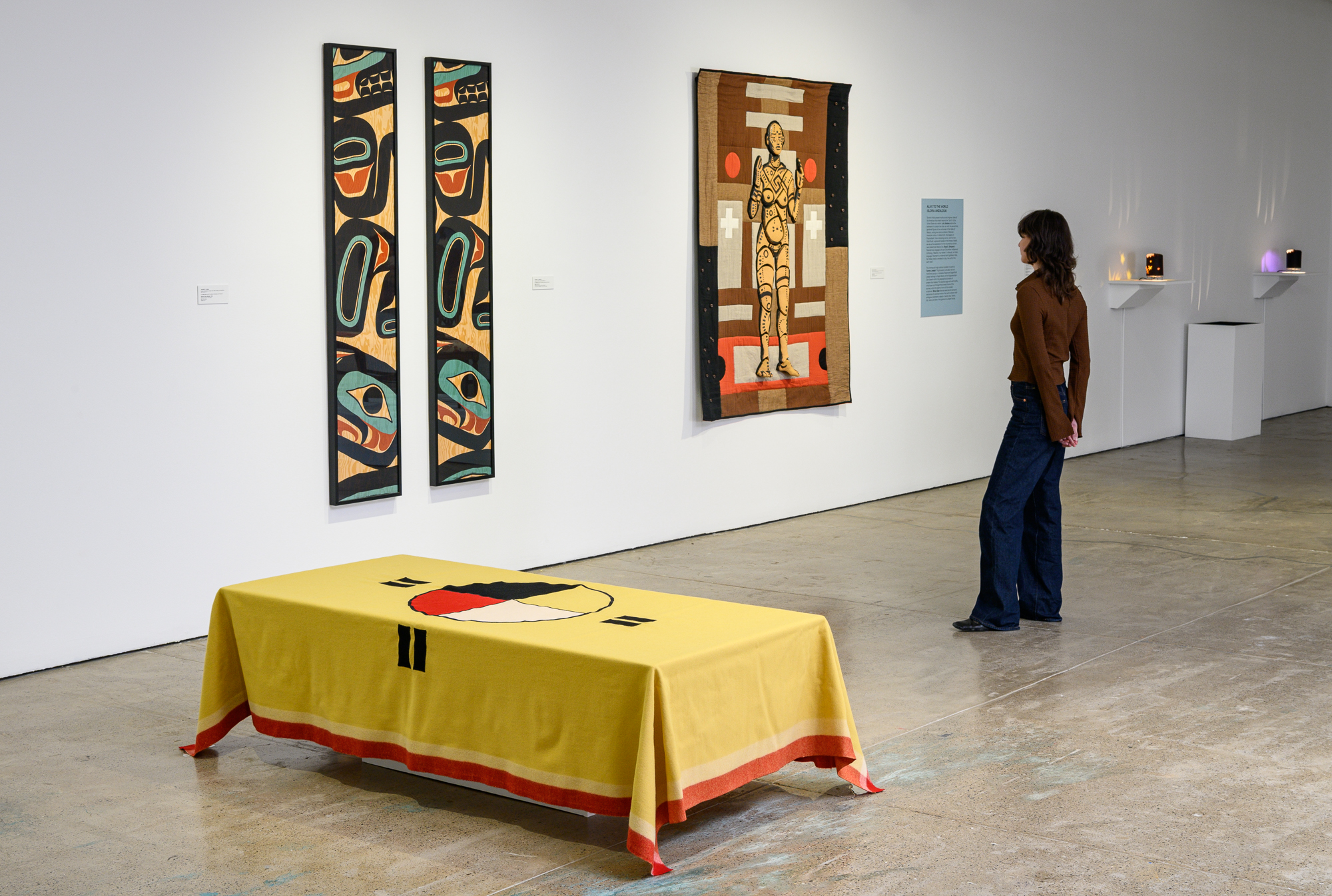
A gallery view of three artworks, including a blanket overlaying a low-rise box, two vertical scarves, and a blanket featuring a ceramic goddess figure.
Some American Dreams (installation view), 2026. Photo credit: Constance Mensh.

As the nation marks 250 years since the signing of the Declaration of Independence, The Fabric Workshop and Museum presents Some American Dreams, an exhibition that grapples with the complexities of American identity and belonging. We asked FWM Curatorial Fellow Hilde Nelson, who organized the show, what she discovered while researching the collection and what she hopes such an exhibition can offer for us at this time in our history.

Explore FWM
Why did The Fabric Workshop and Museum decide on this specific exhibition to represent America's 250th anniversary?

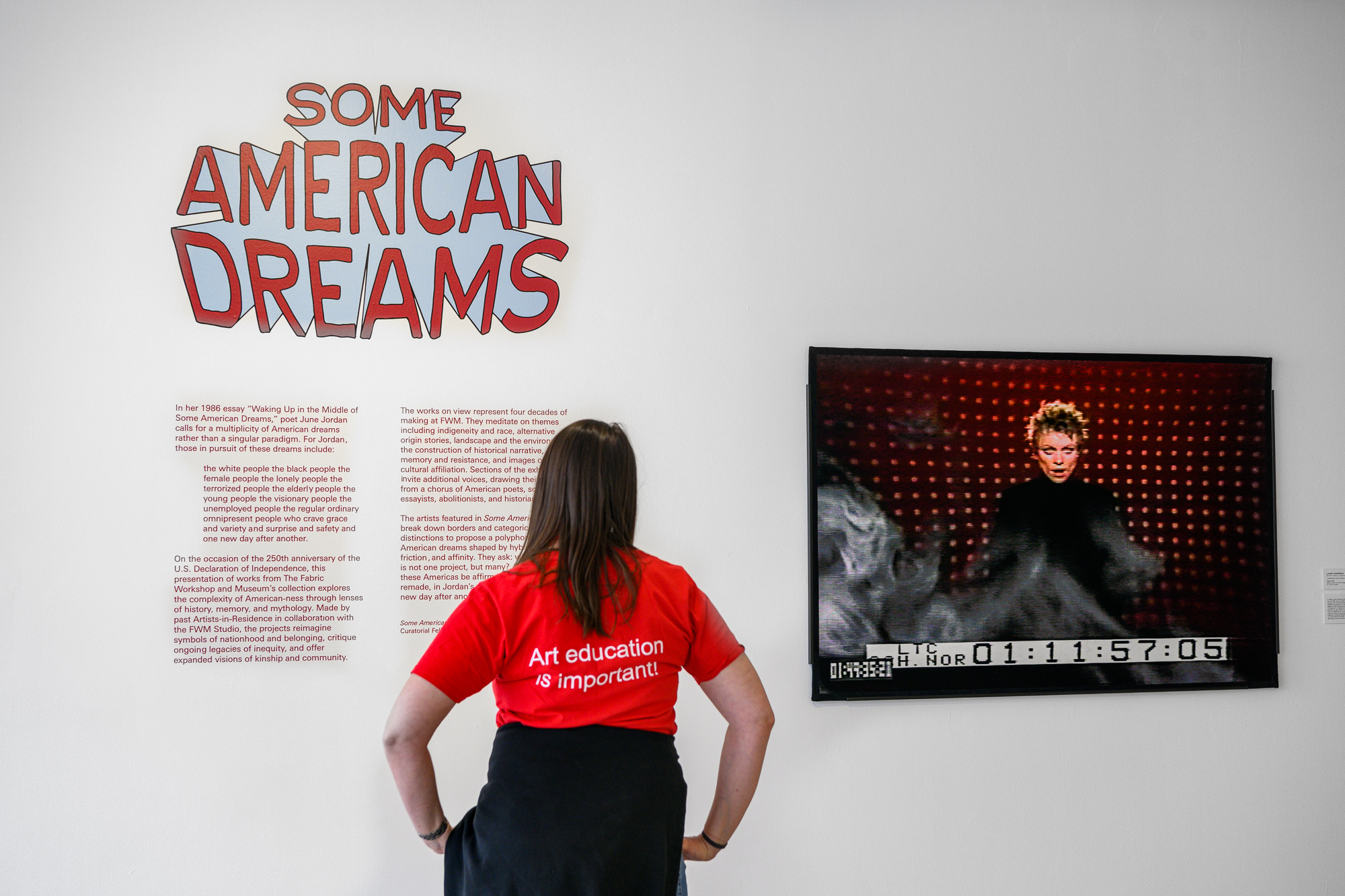
Some American Dreams (installation view). At right: Laurie Anderson, Frame, 2000. Photo credit: Constance Mensh.

Why did The Fabric Workshop and Museum decide on this specific exhibition to represent America's 250th anniversary?

HN: Many institutions around the city of Philadelphia are responding to the 250th anniversary of the Declaration of Independence as a kind of marker of this nation’s history. And here at the Fabric Workshop, we have for nearly 50 years—our 50th is going to be next year—been working with artists to design and realize creative projects and to experiment with their practices. And for us, this was an interesting lens to start looking back through our collection and thinking about ways that artists have responded to the idea of America [or] the American project through their projects here at the Fabric Workshop. This exhibition has been very artist driven in their response to these questions of what even constitutes the idea of America. What does it mean to be American? And in a lot of ways, I think this has allowed us to open up and explore those questions. Some American Dreams came out of the idea of, what if there’s not one America, but many? What if it’s not one dream, but many dreams? How can they can align with each other, and how can they be in contradiction with each other, and produce new understandings of this idea of nationhood at this historical moment, especially here in the city of Philadelphia? 


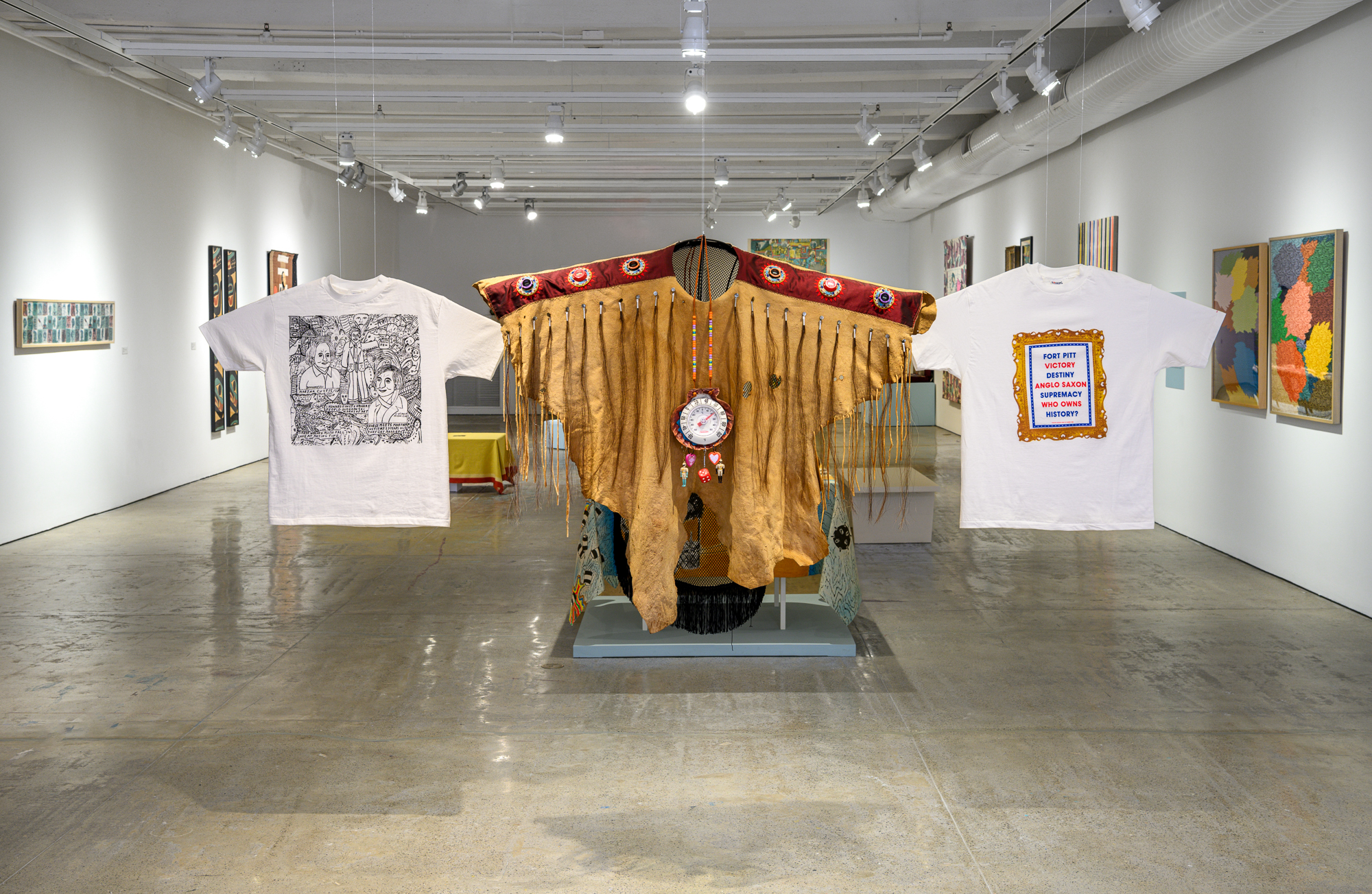
A gallery installation showing three garments, including two t-shirts and a Native American shroud.

Some American Dreams (installation view), 2026. Photo credit: Constance Mensh.

What do you think about the idea of museums as a neutral spaces? How does that factor into the exhibition?

HN: I don’t think the museum is a neutral space at all. I think of the museum as an institution [that] from its very founding has always been tied to ideas of nationhood, of who can participate in a citizen body, who can be a model citizen, and a lot of that is tied to the collection and presentation of art.  

The title Some American Dreams comes from a 1986 essay by the poet June Jordan, and what she’s describing in this essay is trying to unpack and resist the idea of American individualism as being the ultimate dream and instead calling for practices of collectivity, of solidarity with one another, and how that can open up new kinds of experiences and belongings. In thinking about “some American dreams,” this exhibition is not only saying that there’s a plurality. Whose stories get to be told and who tells those stories is inherently political. Hopefully, it’s also a reflection of the fact that some is only some. We’re very lucky that many artists are always questioning who has the power and who that story is being told to, and how they can relate to that material.


How did FWM decide which artists to feature in the exhibition?  

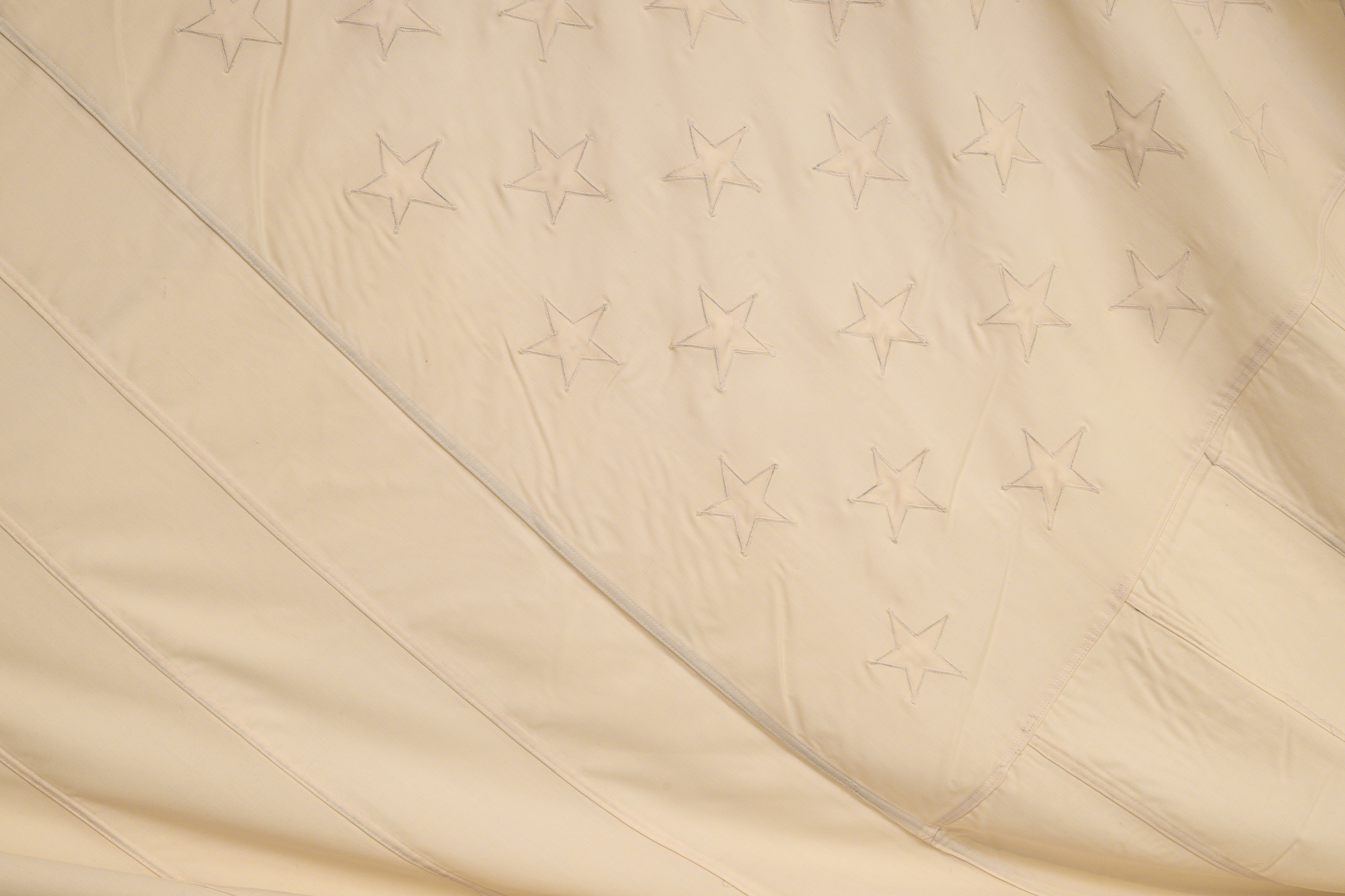
Donald Lipski, in collaboration with The Fabric Workshop and Museum, Philadelphia. "Who’s Afraid of Red, White and Blue #37," 1990. Photo credit: Constance Mensh

How did FWM decide which artists to feature in the exhibition?  

HN: I went through the entire collection, which took me a little while. There’s such a breadth of work to look through, but there were some that were maybe a little more obvious. I’m standing in front of a flag work by Donald Lipski [which was created] during his time here in 1990. Most of the works he produced incorporated the American flag in some way, shape, or form. This is directly dealing with an American symbol that is at once a formal object and one that’s loaded with cultural and political symbolism.  

But I was also hoping to come at it a little more obliquely—the ways that some of these artists were thinking about landscape and how that ties to our understandings of the nation. So much American art is tied to the genre of landscape and how they’re undermining or rethinking it. The works here are maybe explicitly dealing with this question of America, and some maybe less explicitly, but more around the question of experiences of this nation and beyond it. I also wanted to think beyond the United States as a national border, and to think about America and the Americas more broadly, and also to think beyond 250 (even as much as this exhibition is responding to an historic milestone), to earlier ideas of origins and longer histories of living in this space, especially Indigenous histories. 


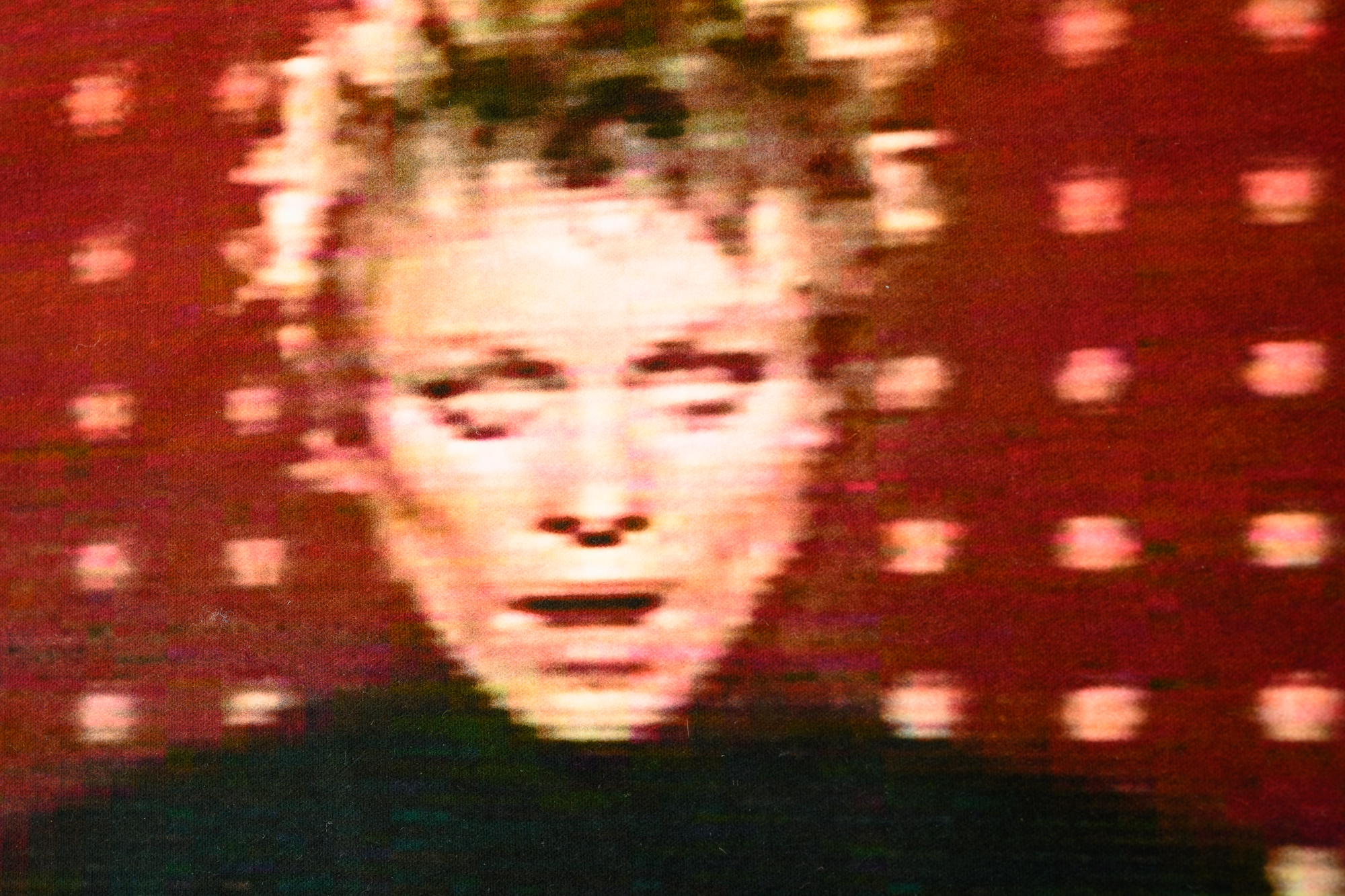
A detail of a rug artwork by Laurie Anderson that is a film still from her music video, O Superman. The focus is on the artist's face, a white woman with short blonde hair, staring at the viewer in front of a red environment. The pile of the rug mimics the film grain, pixelating her image.

Laurie Anderson, in collaboration with The Fabric Workshop and Museum, Philadelphia. "Frame" (detail), 2000. Photo credit: Constance Mensh.

Which is your favorite piece in the exhibition and why?

HN: Choosing a favorite piece in the exhibition is like asking which of your children is the favorite, so it’s a difficult question, but I would like to highlight a couple of works. The first work that you see in this exhibition is a work by Laurie Anderson, from 2000, [which is] a film still from the music video for her 1981 song Superman, which is probably the song that people most recognize her for. And that song is a reworking of an aria from the 1885 operaLe Cidand in her version, [she’s] singing, Oh Superman, oh judge, oh mom and dad, [about] American might, American power, petrochemicalstechnology. And what I really love about this work is that she’s taking something and translating it from the medium of video into textile, a rug, and the pile of the rug and the fact she’s included the timestamp kind of gives it that grain of video. So, I love the fact that it’s pulling on a lot of thematic strains that will merge throughout the exhibition.


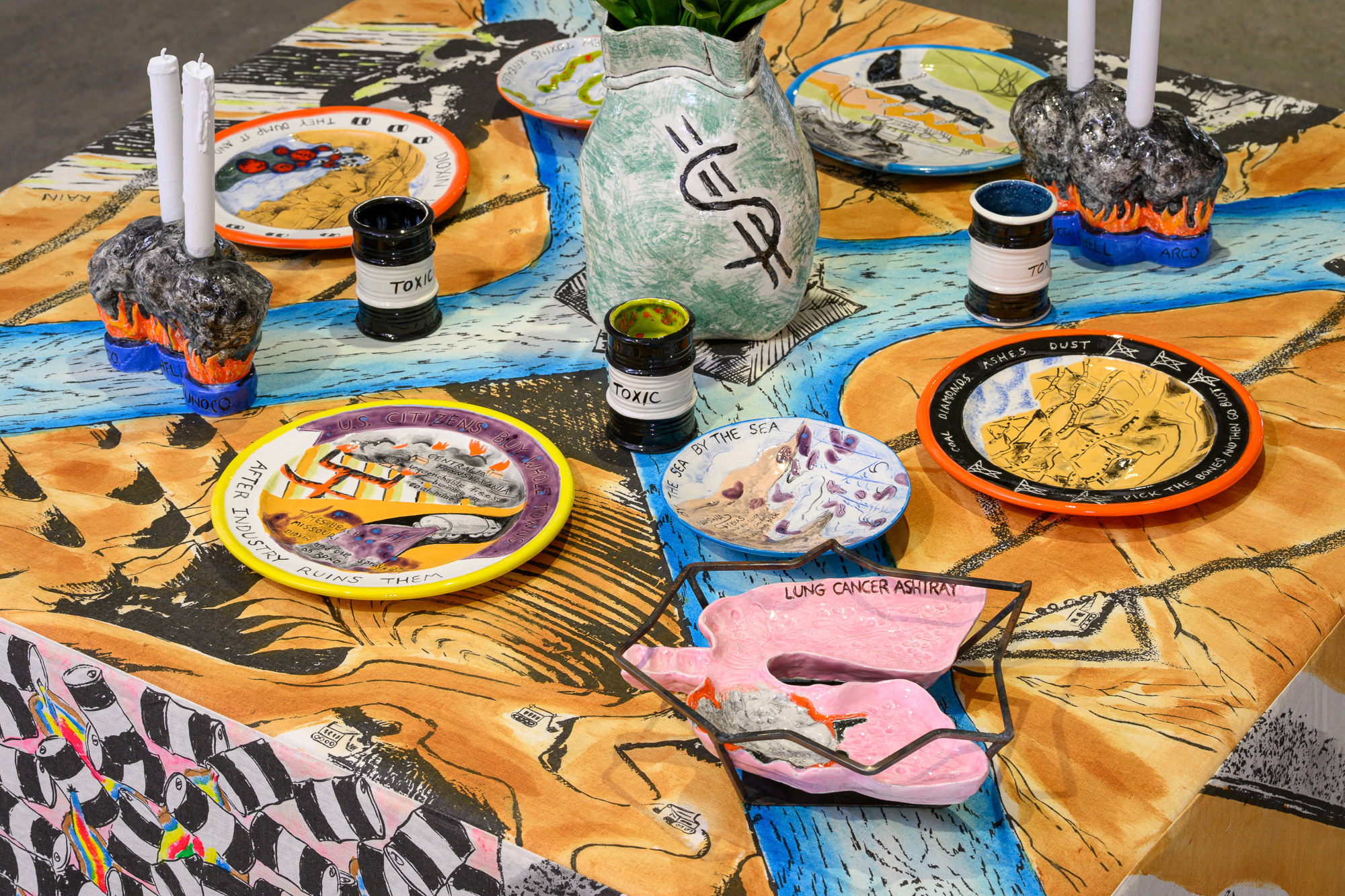
A tablescape showing an arrangement of ceramic plates, candle holders of smoky oil plumes, cups that resemble toxic waste barrels, a vase with a dollar sign, and an ashtray resembling cancerous lungs.

Becky Howland, in collaboration with The Fabric Workshop and Museum, Philadelphia. "Toxicological Tablecloth" (detail), 1984. Photo credit: Constance Mensh.

The newest work in the show, is Rose B. Simpsons Tonanzin from 2022. I find it really fascinating because Tonanzin is an Aztec goddess [and] the fact that her body is made of the very stuff that she is the deity of, I think is really moving and tied to Simpson’s own relationship to motherhood and maternity. There’s a beautiful, wider cultural mythology tied into it, and also a very personal connection to the work.  

As part of this project, we’ve been able to pull out works that haven’t been on view in quite a while. It‘s been really exciting to go through the collection in that sense. Often, when you’re curating a show, you‘re working from tiny little reproductions, and to see things in space can really open up new ideas and reactionsFor me, Becky Howland‘s Toxicological Tablecloth from 1984 was a real surprise. [She’s] created this installation of a dining table in essence, and that space of consumption is being used to think about our consumption of the Earth and environmental disaster. Not only does the tablecloth itself include references to acid rain and coal mining, but the ceramic table settings that she’s made are referencing individual disasters and greater combinations of our relationship to the environment. But what I really love about it is the fact that she has really cannily used glazes to evoke oil spills, so there’s a real sense of material relationship to the thematic work that she’s showing.  


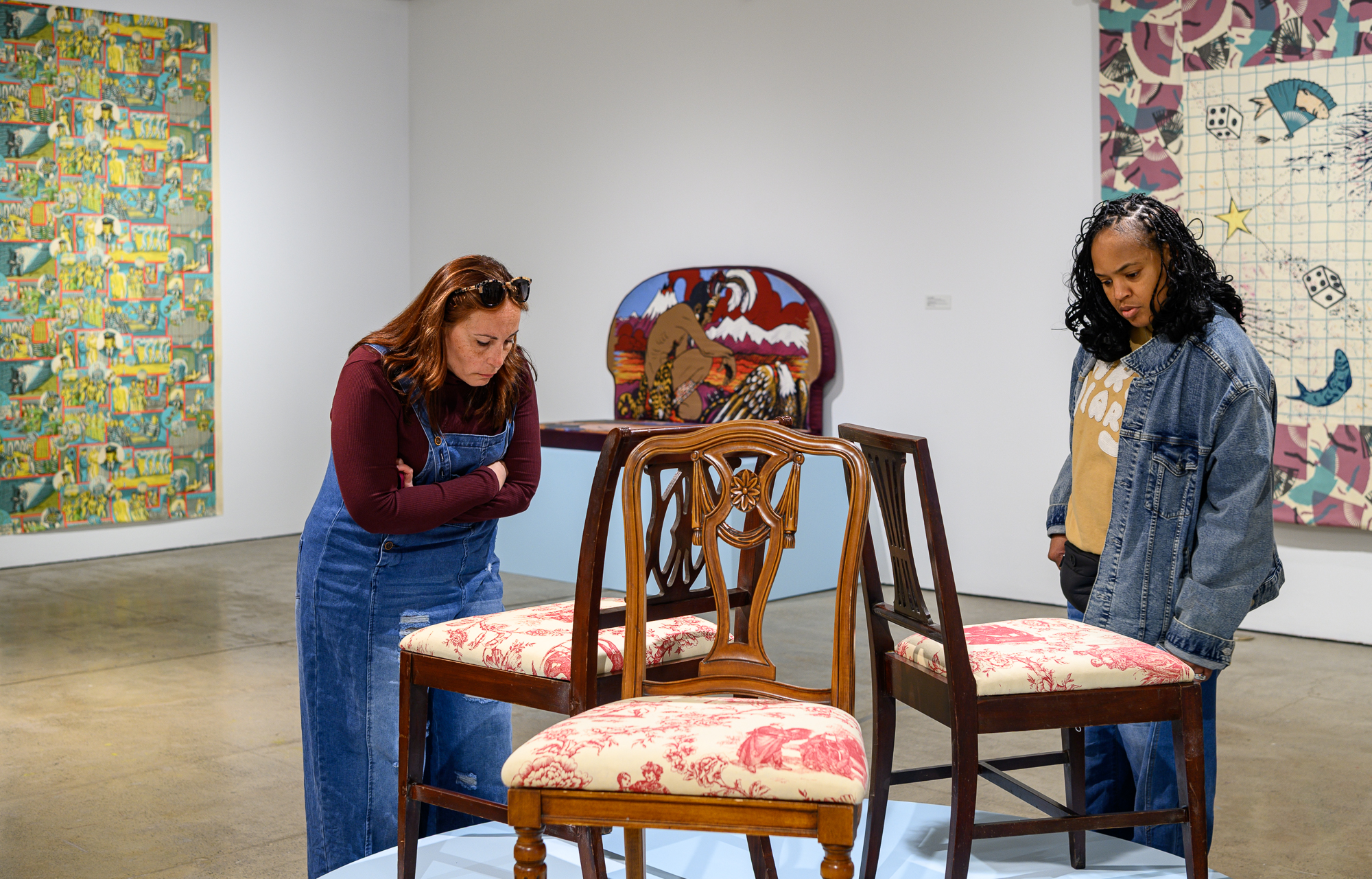
A picture of two women looking at a set of three chairs upholstered with detailed imagery. Behind them are more artworks with patterns and illustrations.

Some American Dreams (installation view), 2026. Photo credit: Constance Mensh.

Who is your target audience for this exhibition? And how are you hoping they interact with the works?

HN: I want this [show] to speak to people who are reckoning with this question of America at this moment of the 250th [anniversary]I really hope that this can be a place for people to maybe not see themselves as within this kind of patriotic project, but to see themselves in a complicated relationship to what this nation [represents]. [People may] say it has value and meaning for me, a sense of belonging, or [these are] the ways it’s difficult for me to think about my relationship to the United States or to America. [I hope visitors will] be able to come into this space and look at the ways that artists are having very complicated conversations about what it means to be a citizen, to live on this land, to be a non-citizen, [or] to be an occupant of this land before the United States was even an idea.

I hope the audience comes in with curiosity. I actually don’t expect them to agree with all of it, necessarily. Some of this work is perhaps more celebratory, and some more critical. I offer up that whiteness is a huge question and problem in a lot of these works, and that may become somewhat confrontational. But I hope it opens up people to seeing the kinds of systems and structures that underlie so much of the content of our life here in the United States, and how we can reckon with that and wrestle with it productively. I hope they come with curiosity. I hope they leave with questions. Honestly, I think that’s the most powerful thing that art can do.


A gallery installation featuring two visitors, one walking and one seated, near two large artworks on a wall. Natural light pours in through a window. The artwork on the left is a banner with graphics and text while the artwork on the right is an all-white American flag, twisted and pinned to the wall.

Some American Dreams (installation view), 2026. From left: S.A. Bachman, "Are You Telling Yourself a Little White Lie?," 1988; Donald Lipski, "Who’s Afraid of Red, White and Blue #37," 1990. Photo credit: Constance Mensh.

Is there anywhere that you can see people having a debate or a discussion with the person next to them?

HN: I mean, I think the fact that I opened it with a white American flag next to a giant banner that says, “are you telling yourself a little white lie?” may seem somewhat confrontational, but I’m hoping that these two works [prompt] us to rethink symbols that we take as inherent or naturalized. Part of the reason that the Donald Lipski work is so interesting is that it’s not only engaging with very contemporary political issues [but also] in a longer art historical discussion around the flag as a symbol. The American flag is stars and stripes. There are rectangles and an arrangement of colors. It’s a formal experiment. So he’s engaging with people like Jasper Johns and the mid-century minimalists and these artists who are [asking] what is this as a formal object versus something that we assign a lot of cultural and symbolic value to?

[I put] that in conversation with S.A. Bachman‘s work, which is showing these images of suburban landscape, of the nuclear family, idealized womanhood through the figure of the doll, and asking, are you telling yourself a little white lie? [It opens] up questions of who has access to this, who desires this vision? As you step off the elevator, [these two pieces] can prompt a rethinking of all the objects that you encounter.


In FWM's collection, the artworks are not only made by contemporary artists but also the result of a collaboration with an in-house studio. What's it like going through the archives understanding how these projects evolved?

HN: Part of this project, and part of how I think about curatorial work in general is that the process of making a work and of putting together an exhibition are all intensely collaborative and involve an incredible amount of hands and different kinds of expertise and labor. I’m very invested in the idea of the chorus—in the idea of many voices involved in the room. I am so privileged to be here at the Fabric Workshop, which is so driven by an intense and productive collaboration between the Studio staff and the artists themselves. Not only are these works the product of many hands, of people who have expertise in textile, people who have expertise in furniture, in screenprinting—the lifeblood of the Fabric Workshop. [Expertise is] both in the making of the work, and also in the people who installed the exhibition, the people who edited the labels, the people making this very [interview], the people who you see coming into this exhibition space, who are not only helping to guard the art, but helping to have a conversation with you about the work.

This work doesn’t happen without all of them. And I hope that not only is this a reflection on the plurality of American dreams, but it’s about the plurality of the artmaking and the plurality of an arts institution. I think it is only as a result of that collective that we can do anything. So as June Jordan says, we need to believe in that collective.