In her sculptures, installations, and drawings, Becky Howland critiques exercises of power and their precipitation of industrial development, the degradation of bodily and societal health, and ecological catastrophe. This is epitomized in her best-known work, Brainwash (1981–1982), which consisted of a working fountain in the backyard of the ABC No Rio art center in the Lower East Side. The project was notable for its critique of militarization, industrialization, and environmental destruction. Howland populated its visual excess with coal, diamonds, machine guns, human brains, frogs, transmission towers, and a panoply of corporate logos.
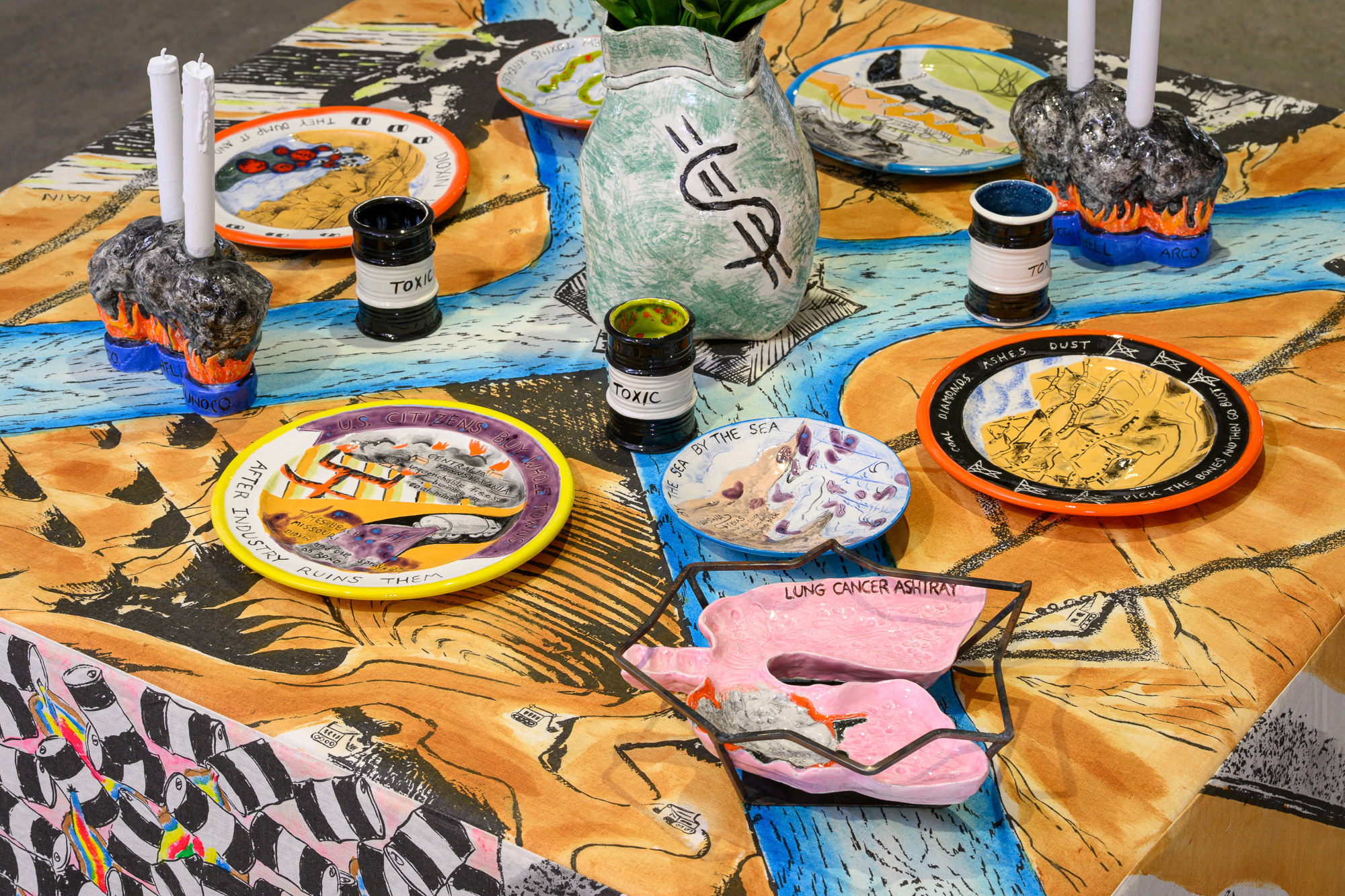
Designed and screenprinted during Howland’s 1985 residency at FWM, Toxicological Tablecloth continues the aesthetic program of Brainwash. The project carries several familiar motifs: running water, spilling oil barrels, mines, and bombs. Two rivers intersect to divide the field into four quadrants of desolate wasteland pillaged by factories and industrial excavation. An 8-ball appears at the nexus, roiling in the crosshatches that denote the currents. The tablecloth’s overhang extends the theme with more vignettes: tumbling oil barrels spew vividly pigmented toxic waste; a torrential downpour of acid rain falls sideways from a billowing cloud, contaminating a river; a coal plant generates its own black cloud that pushes upward toward the table’s surface. Howland envisions environmental collapse as total and vertiginous. The viewer’s god’s-eye perspective of the scene, which suggests a kind of visual dominance, reveals only a bleak landscape stripped bare of life and resources.
In a satirical gesture, Howland sets the table in anticipation of unknown guests. Her ceramic dinner set includes toxic waste barrel cups, ashtrays modeled into infected lungs, candlesticks in the form of massive, fiery oil drums from Sunoco, Shell, and Arco, and a large money bag vase. Her plateware chronicling episodes of American ecological disasters literalize the violent consumption of the earth by practices of extraction. Each is adorned with a couplet such as “Coal, Diamonds, Ashes, Dust—Pick the Bones and Then Go Bust,” “Dioxin Kills, They Dump Its Spills,” and “Flood Waters Recede, New Toxins Revealed.” The plates are flanked by napkins decorated only with an image of a time bomb, its flaming fuse starkly contrasting with the soft blue ground of the textile. At Howland’s dinner table, consumption is not a matter of survival or pleasure, but excess and devastation.
As Howland wrote in a 1986 artist statement, “My table is the opposite of the old saying ‘eat the rich.’ It shows how the consumer is consumed by industry—how we’re all being poisoned in our day to day life.” The resulting installation does not merely lay bare the environmental destruction wrought by the sheer proliferation of capital. It goes further, implicating the viewer in its daily abuses of land and community.