Artist-in-Residence

Yinka Shonibare CBE RA

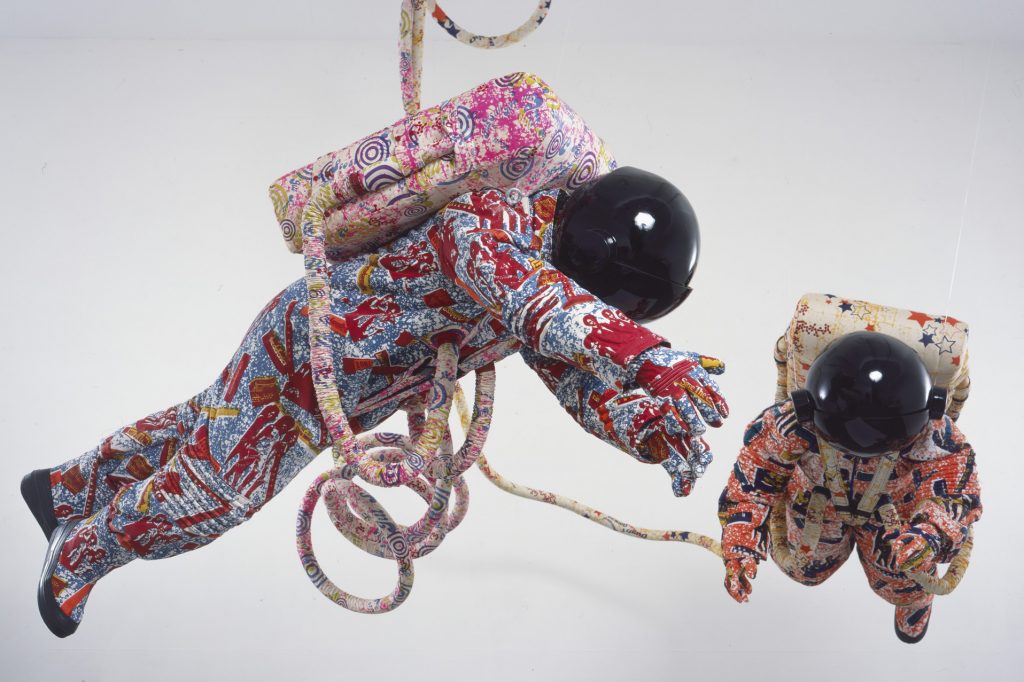
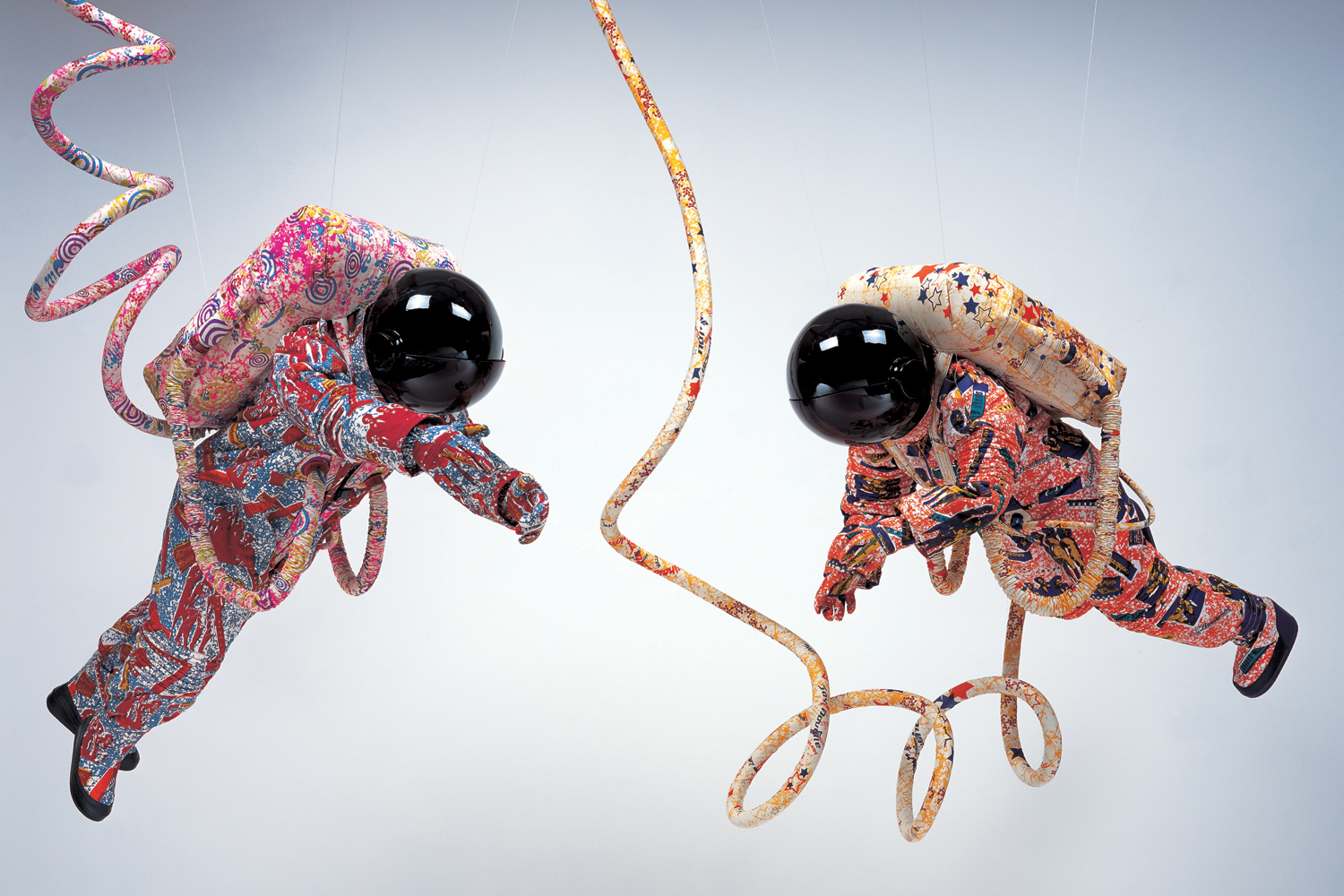
Color photograph in landscape orientation. This photo is of the piece titled “Space Walk” by Yinka Shonibare. There are two astronauts wearing space suits on opposite sides. The astronaut on the left is leaning forward to the right with their hands out in front of them. The suit is a red and blue batik patterning, as well as the gloves and boots. The backpack is a large rectangular shape, with a pink, turquoise, and yellow print that has splatters of paint and spirals on it. Coming from the side of the backpack is a long tube of the same print, coiling down and then up out of the frame. The astronaut on the right is floating, leaning forward with their hands out in front of them. The suit is a blue and orange batik patterning, as well as the gloves and boots. The helmet is all black. The backpack is white with an orange batik print and orange and blue stars on it. There is a tube coming from the side of the backpack of the same print, coiling down and then up out of the frame. The astronauts are in a white exhibition space.
Yinka Shonibare CBE RA, in collaboration with The Fabric Workshop and Museum, Philadelphia. Space Walk, 2002. Fiberglass, silkscreen print on cotton sateen and cotton brocade, and plastic, Dimensions vary with installation. Edition 1 of 2. Photo credit: Aaron Igler.

While not new to fabric as an artistic medium, Yinka Shonibare CBE RA had the freedom during his residency at FWM to create custom print designs for the textiles that would clothe figures in a new installation. Titled Space Walk, the installation ventures into the new frontier of American exploration—space. A man and woman—dressed in brightly colored space suits, and wearing backpacks and helmets—float near a half-scale fiberglass and wood copy of the Apollo 13 shuttle. Pioneers of space, the couple refashions concepts of expansion, exploration, and potential colonization.

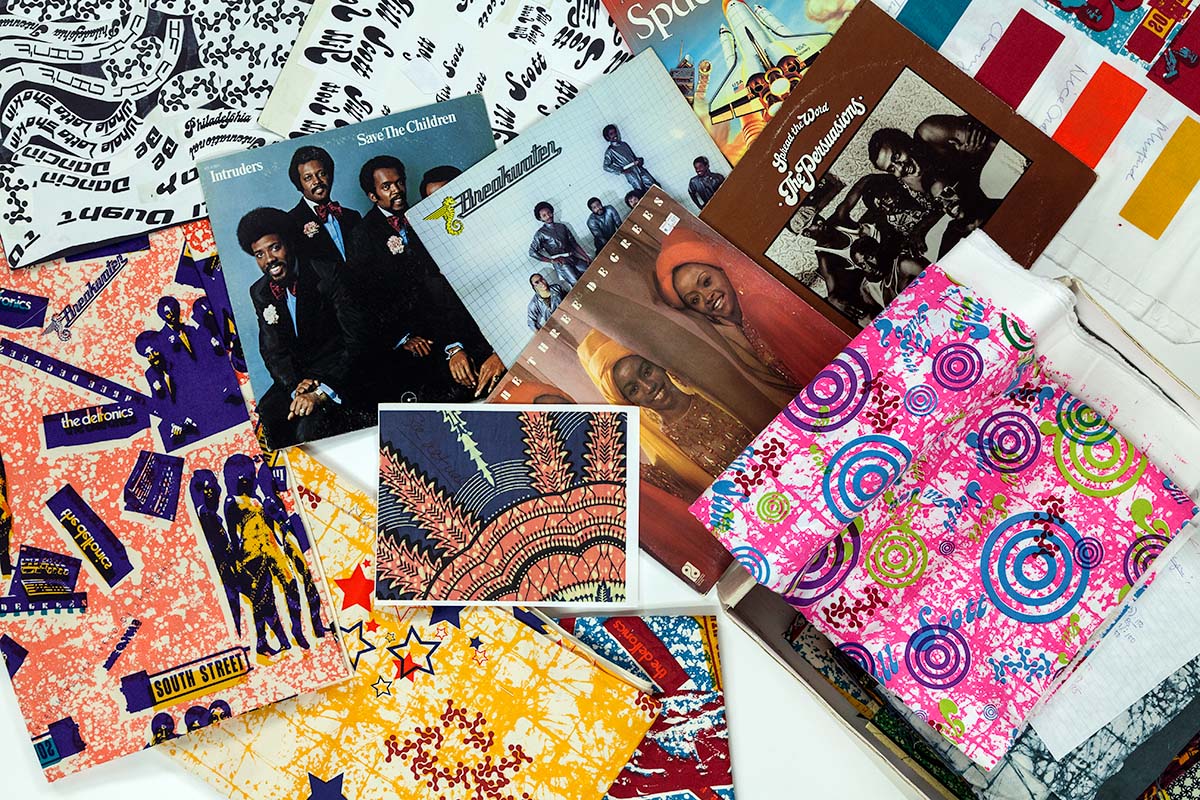
Shonibare designed four new fabrics for Space Walk. Based on the Dutch wax-printed batiks he has often used in previous work, the new designs recreate a batik patterning not through the traditional wax method, but through silkscreen printing. Two batik designs were created—one based on a traditional batik drip patterning, the other on a grid—and they were used as background for the printed textiles. The handmade quality of the prints was emphasized by printing the repeat pattern off-register; in other words, with each printing of the design, the silkscreen was allowed to move so the patterns do not align perfectly. The dominant motifs—drawn from the late 1960s and early 1970s music tradition produced in Philadelphia, known as the “Philly Sound”—are layered on the batik background. The artist borrowed images, text, and photographs from record albums of such period bands as The Intruders, Three Degrees, The O’Jays, and contemporary singer Jill Scott. Shonibare made a master drawing, which was then transferred to silkscreens for printing. Characteristic of Shonibare’s work, the colors of the textiles are vibrant oranges, turquoises, and reds, another reference to the Dutch wax fabrics on which the designs are based.

Art


From the Archive


Artist Bio

British, born 1962. Lives and works in the East End of London, UK.

Yinka Shonibare CBE RA was born in London and raised in Lagos, Nigeria, where his family moved when he was three. He returned to London at the age of 17 to study fine art, first at Byam Shaw College of Art (now Central Saint Martins College of Art and Design), and later for his MFA at Goldsmith’s College, University of London. In 2004, Shonibare was shortlisted for Britain’s prestigious Turner Prize, and in 2005 was bestowed the distinction of Most Excellent Order of the British Empire (MBE). He received an Honorary Doctorate (Fine Artist) of the Royal College of Art in 2010 and was awarded a Commander of the Order of the British Empire (CBE) in 2019, titles now added to his professional name.

A major retrospective of Shonibare’s work was mounted by the MCA Sydney in 2008 and traveled to the Brooklyn Museum and the Museum of African Art at the Smithsonian Institution, Washington DC. His one-person shows include a major exhibition at the Studio Museum in Harlem in 2002, and others organized by the Tate Britain in London (2001), The Andy Warhol Museum in Pittsburgh (2001), the Victoria and Albert Museum in London (2000), and the Art Gallery of Ontario in Toronto (1997). His work has been exhibited internationally at the Venice Biennale as well as at Documenta 10 (2002).