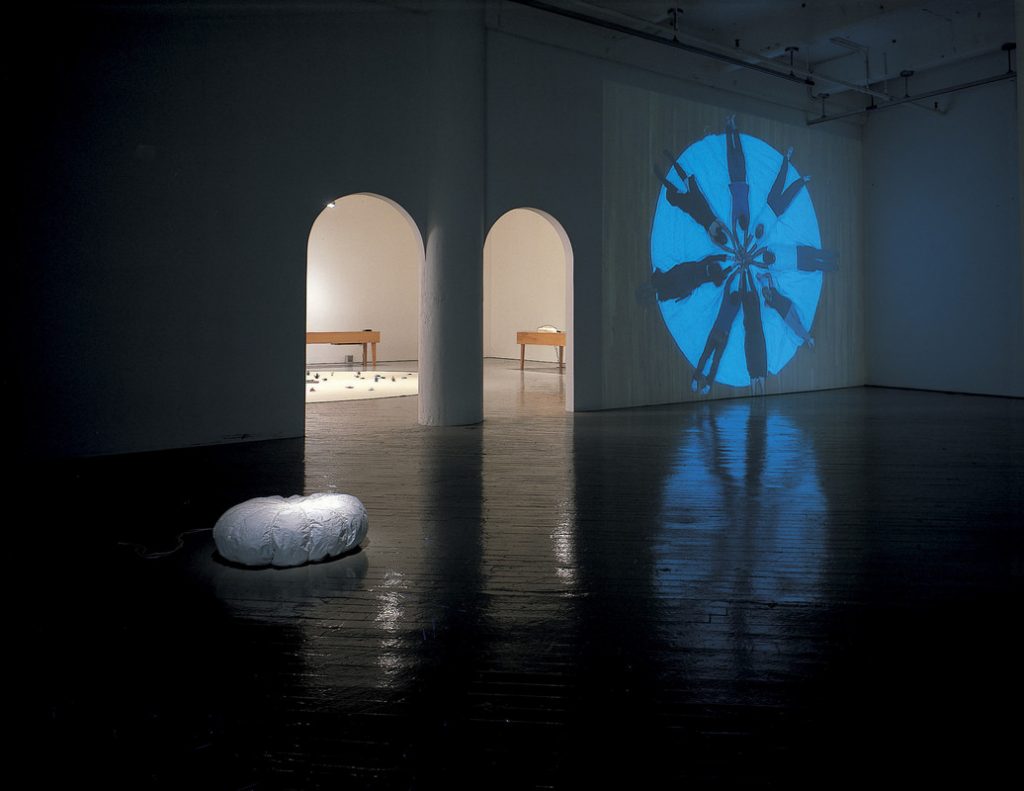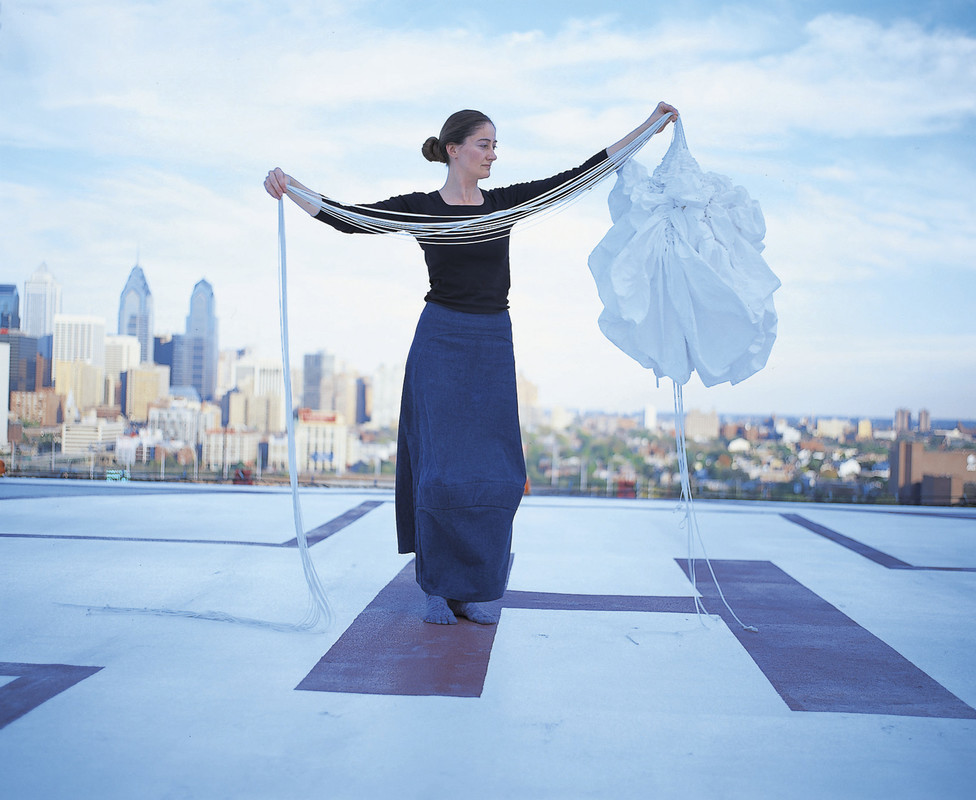
In collaboration with FWM, Marie-Ange Guilleminot created Sea Urchin, a sculptural object that, like many of her previous works, derives its meaning from its potential to be transformed. In this case, the simple materials of Tyvek® and rope are ingeniously designed to create a cape, pillow, skirt, parachute, and tent—the object can be transformed from one incarnation to the next by using the system of rope pulls, which are made functional by a series of sliding and end knots. The potential forms of Sea Urchin range from garment to shelter to mode of transportation, and un geste—a gesture—connects them to one another. Guilleminot’s final touch was to apply a shimmering silver-blue metallic paint to the closed form of each Sea Urchin; in its virgin state the form glows discretely, yet once it is opened and transformed, it can never again return to this same pattern.
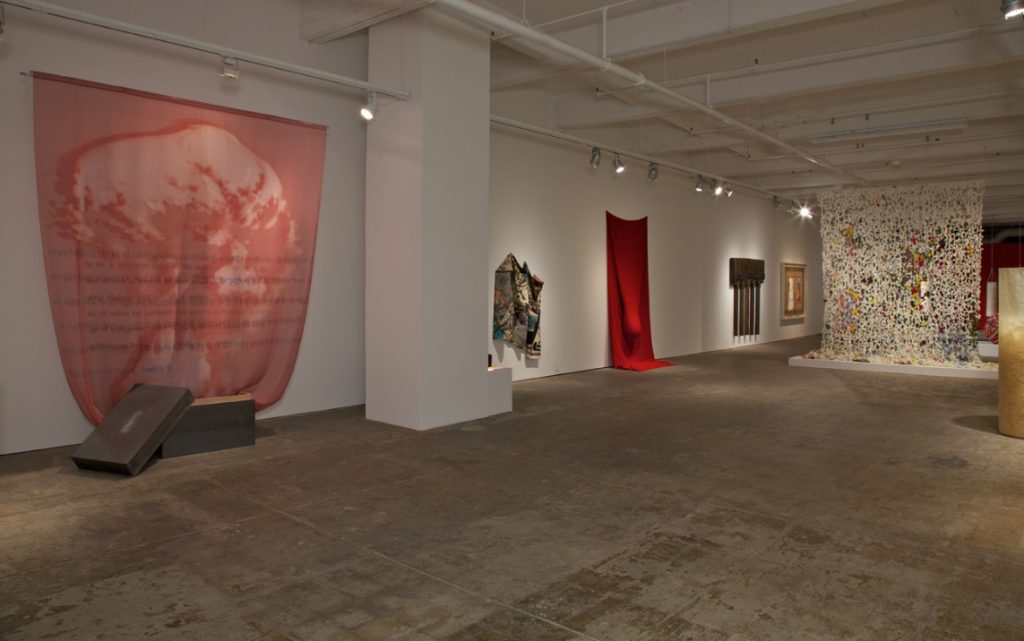
In 2000, Guilleminot exhibited Sea Urchin—in two sizes (120 cm in diameter and 400 cm in diameter)—at FWM as part of a larger show entitled Nevers/ Hiroshima. The exhibition brought Sea Urchin together with other works for which Guilleminot has become known. The first, Transformation Parlor, was originally shown at the 1997 Venice Biennale and involves a circular space of 4 meters in diameter in which visitors learn origami techniques. Specifically, participants are taught how to make the Tsuru bird, a Japanese symbol of hope and longevity which has become a symbol used to commemorate those who perished in the 1945 bombing of Hiroshima. The second project is Hiroshima Collection (1998), in which the artist remakes garments worn by victims on the day of the World War II bombing as a gesture of care and restoration. Guilleminot linked these works after one of her experimentations with Sea Urchin led her to float the parachute form to the floor; she watched as it opened and took on the shape of the mushroom cloud of Hiroshima.
Guilleminot’s FWM residency was undertaken in conjunction with the San Francisco Art Institute, where the artist experimented with the transformation of Sea Urchin with students, and created two videos of these performance dialogues, entitled Dialogues–Sea Urchin, Ø120 and Test–Sunday 31 October 1999 (1999). Guilleminot wrote about the videos: “These experiments with Sea Urchin exist as demonstrations against the use of atomic testing.”