Ecke Bonk is a German conceptual artist. Enigmatic and elusive, the artist has even published his work under aliases, only revealing his authorship later. During his 1987 FWM residency, Bonk’s projects could be characterized by their practical simplicity. Combining his experience as a typographer with his artistry, Bonk stripped the designs to their barest essentials while ensuring they remained comprehensible.
NO/ON Pillow was the first project conceptualized during his residency. Each edition is a pair; the individual pillows are printed with an “N” or an “O” to create a simple anagram. Right-side up or upside down, the letters read the same, but their sequence changes the meaning. Bonk specified that the pillows be sewn with square-shaped foam inside so as to eliminate the form’s traditional soft edges.
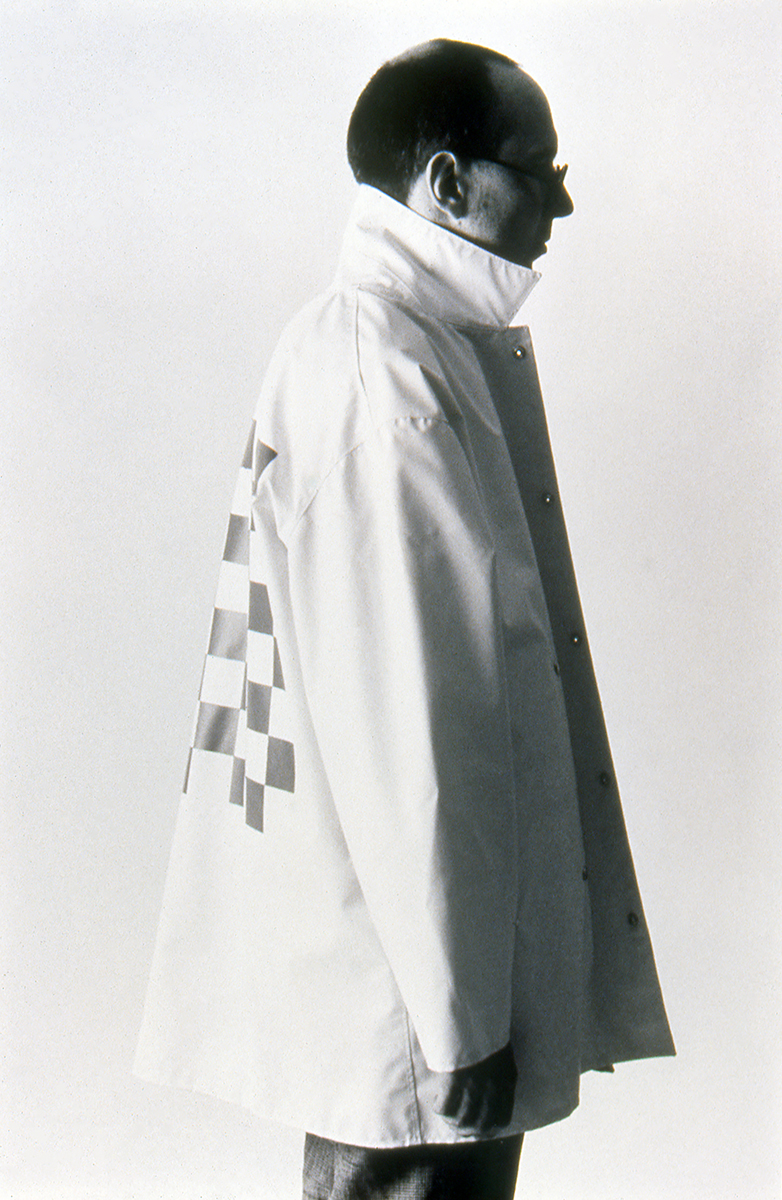
During his time at the Workshop, Bonk also began working on Chess-Jacket (Checkett), an oversized unisex coat with a 64-square chess board silkscreened on the back. The jacket’s transparent interior pockets hold 32 screenprinted plexiglass chess pieces, equipping its wearer with the readiness to challenge an opponent anytime, anywhere. An admirer of the French American conceptual artist Marcel Duchamp, Bonk sourced the symbol for his set’s knight from the logo created by Duchamp for the avant-garde group, Knights of the Société Anonyme. Though the final edition would not be completed until 1991, an initial prototype was made in collaboration with the Workshop’s production team. Bonk liked the idea of a conventional yellow rubber rain jacket printed with a chess board; however, it was found that the dyes required for printing were too toxic for continued use.
When Bonk returned to Germany, he formed a relationship with the company Gore-Tex. They agreed to fabricate his jackets through a process that would not use toxic dyes for printing. 32 editions of “Checkett” were completed, corresponding to the number of pieces on a chess board. The relationship between manufacturer and artist was so amicable that Gore-Tex granted Bonk the use of their patented fabric for another project. The artist cut Gore-Tex fabric into squares, painting each with a vibrant monochromatic color to create 64 Squares (Ideal Surface, Part III). Bonk returned to The Fabric Workshop and Museum in 1991 for an exhibition of his three works.