Artist-in-Residence

Anish Kapoor

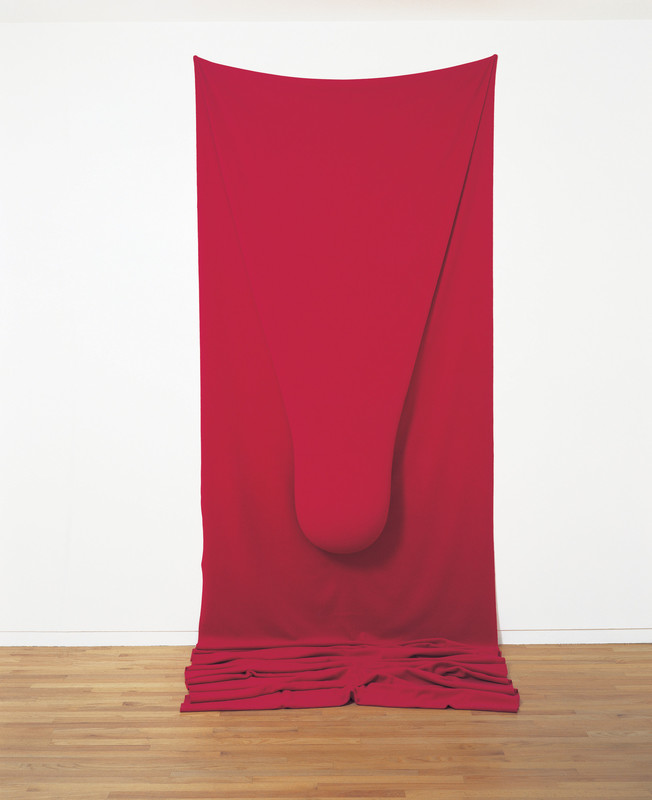
An exhibition view of Anish Kapoor's sculpture titled Body to Body
Anish Kapoor, in collaboration with The Fabric Workshop and Museum, Philadelphia. Body to Body, 1997. Wool and fiberglass, 115 x 58 x 9.5 inches (292.1 x 147.32 x 24.13 cm). Edition 2 of 2. Collection of The Fabric Workshop and Museum. Photo credit: Carlos Avendaño.Reference number: 61517.

Anish Kapoor collaborated with FWM to explore the possibilities of felted and woven wool—both handmade and industrially-produced. Although the medium was entirely new to the artist, the resulting series of sculptures shares its overall aesthetic sensibility with the whole of Kapoor’s oeuvre. Color and form are paramount, playing an allegorical role in communicating the sculptures’ meaning. The color red, for example, is primary in Kapoor’s work; through non-verbal cues, it denotes the intimacy of the body through associations with blood, sexuality, birth, and death. As three-dimensional objects, Kapoor’s forms often use illusion to heighten the sense of depth or lend mystery to the piece. Curving, organic, sensuous shapes, the sculptures often evoke the human body, particularly wombs, navels, and phalluses.

Body to Body is formed by the artist’s careful manipulation of layers of woven felt, supported in part by a fiberglass structure, which allows the hanging, bulbous form in the sculpture’s center to hold its shape. The long, sensual drape of deep red felt spills onto the floor, pooled in rippled valleys of cloth. In Untitled, Kapoor transforms a large white square of industrial felt by simple twists, folds and turns, and then imbeds a red wool sphere in this undulating field of white.

The essence of Kapoor’s artistic practice is to evoke a sense of mystery, or the experience of the sublime. In a 2000 interview on BBC radio, Kapoor explained of his work: “As an artist, I suppose that one of the things I’m working with is mystery. I sense also that we all have a deep need to believe. I think that process of wishing to believe is mysterious. It’s one of the things I’m feeling my way towards” (Belief, BBC Radio 3, December 28, 2000).
Artist Bio

British, born 1954 in Mumbai, India. Lives and works in London, UK.  

Anish Kapoor is an internationally renowned contemporary artist known for his sculptural and public installations that play with scale, space, form, color, and perception. Kapoor completed his undergraduate studies at Hornsey College of Art in Middlesex, England before completing his post-graduate studies at Chelsea School of Art (now Chelsea College of Arts at University of the Arts London). In 1990, he represented Britain at the 44th Venice Biennale where he was awarded the Premio Duemila for Best Young Artist. The next year, he won the prestigious Turner Prize, awarded by the Tate Gallery, London. Kapoor was granted CBE honors in 2003 and knighted for his services to the visual arts in 2013. Solo exhibitions of Kapoor’s work have been presented at ARKEN Museum of Contemporary Art, Ishøj, Denmark; Palazzo Strozzi, Florence, Italy; Serralves Museum, Porto, Portugal; the National Gallery of Canada, Ottawa, ON;  Kunsthalle Basel, Switzerland; Reina Sofia, Madrid, Spain, and the Guggenheim Museum, Bilbao, Spain, among others. His work resides in international collections including Tate Gallery, London, UK; Hirshhorn Museum and Sculpture Garden, Washington D.C.; Art Gallery of New South Wales, Sydney, Australia; Hara Museum of Contemporary Art, Tokyo, Japan; and Art Institute of Chicago, IL. Prominent public commissions reside at Millennium Park, Chicago, IL; Pollino National Park, Italy; London Olympic Park, UK; and the Israel Museum, Jerusalem, among others.